FD Real Rate of Return: How Tax and Inflation Cut Your Gain
A ₹10 lakh FD at 6.5% earns ₹65,000, but after tax and 5.54% inflation the real result can be negative. See the maths, the formula and what to check.
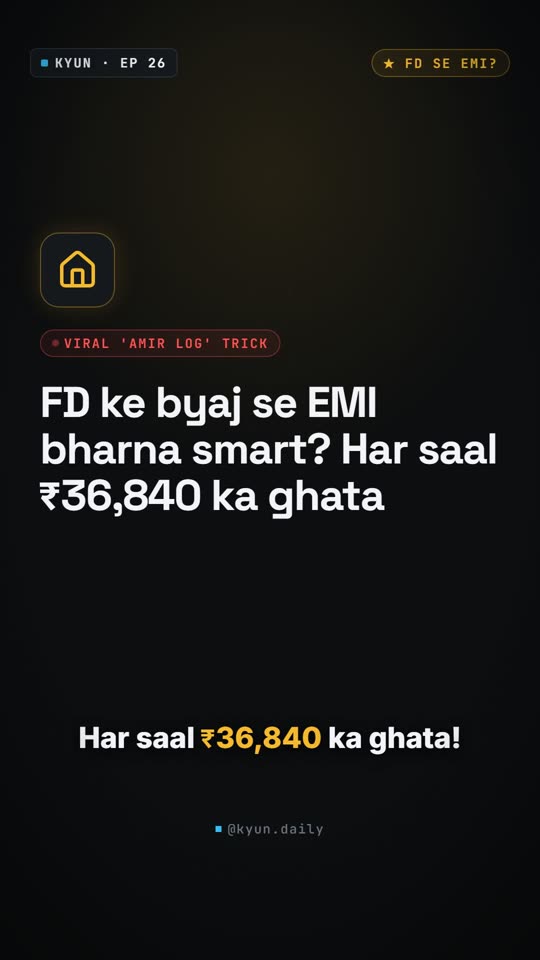
How can a ₹10 lakh FD that pays ₹65,000 in interest still leave you worse off? Because the rate on the deposit receipt is not what you actually earn. Interest is taxed in full, and prices keep rising. On the assumptions below, a 6.5% FD ends the year at -₹3,400 for someone in the 20% slab and -₹9,900 for someone in the 30% slab. The number that captures this is the real rate: FD rate × (1 - slab) - inflation.
This article shows where those figures come from, which parts are solid and which are assumptions, and how to check your own FD.
The rule: tax hits the nominal rate, inflation hits what money buys
The nominal rate is what the bank quotes. The real rate is what is left after tax and rising prices. Two separate things reduce your gain.
- Tax is charged on the full interest. FD interest is taxed at your slab rate on the nominal amount, with no adjustment for inflation (Business Today).
- Inflation reduces what your rupees can buy. If prices rise 5.54%, you need ₹10,55,400 a year later to buy what ₹10,00,000 bought today.
On 23 October 2026, at the NDTV World Summit, RBI Governor Malhotra was reported as saying:
If there is high inflation, then it's like a tax on everyone.
He was speaking about inflation in general, not about FDs. Applying it to FDs is our reading, and it fits: an FD holder loses purchasing power to inflation and then pays income tax on interest that, in part, only makes up for that loss.
The inputs and where they come from
- Inflation: MoSPI's CPI press release for September 2026, issued on 12 October 2026, puts combined inflation at 5.54%, up from 4.83% in August (MoSPI). A summary of the release notes that the CPI base year is 2024.
- FD rate: 6.5% is an assumption. One report of big-bank rates puts 1-2 year FDs at about 6.25-6.50%. Your own FD may pay more or less.
- Tax slabs: under the old regime for FY 2026-27, income between ₹5 lakh and ₹10 lakh is taxed at 20% and income above ₹10 lakh at 30%. We use 20% and 30% as two examples and ignore cess, so your actual tax can differ a little. We have not covered the new regime, so check which regime and slab apply to you.
Worked example: ₹10 lakh for one year
- Interest: ₹10,00,000 × 6.5% = ₹65,000.
- Inflation cost: ₹10,00,000 × 5.54% = ₹55,400. This is the extra money you need just to keep the same buying power.
- Tax: 20% of ₹65,000 = ₹13,000. 30% of ₹65,000 = ₹19,500.
- Interest after tax: ₹52,000 or ₹45,500.
- Real result: interest after tax minus the inflation cost.
| Case | Interest | Tax | Interest after tax | Inflation cost | Real result |
|---|---|---|---|---|---|
| No tax (for comparison) | ₹65,000 | ₹0 | ₹65,000 | ₹55,400 | +₹9,600 |
| 20% slab | ₹65,000 | ₹13,000 | ₹52,000 | ₹55,400 | -₹3,400 |
| 30% slab | ₹65,000 | ₹19,500 | ₹45,500 | ₹55,400 | -₹9,900 |
The same result in percentages: 6.5% × (1 - 0.20) = 5.2%, and 5.2% - 5.54% = -0.34%. At 30%, 6.5% × (1 - 0.30) = 4.55%, and 4.55% - 5.54% = -0.99%. On ₹10 lakh, that is -₹3,400 and -₹9,900. This is the simple subtraction the formula uses.
Look at the first row. Before tax, the real gain is only ₹9,600 (₹65,000 - ₹55,400). The ₹19,500 tax in the 30% slab is about twice that real gain, and even the ₹13,000 tax in the 20% slab is larger than it. The tax is calculated on all ₹65,000, but ₹55,400 of it only covers price rises.
A negative real result does not mean your balance falls. In the 20% case you hold ₹10,52,000 after a year, which is more than ₹10,00,000. But the same basket of goods now costs ₹10,55,400. Your rupees grew; your buying power shrank.
Break-even: what FD rate keeps up?
Set the real rate to zero in the formula and rearrange: break-even FD rate = inflation ÷ (1 - slab). At 5.54% inflation, this is our own calculation from the same formula:
| Slab | Break-even FD rate at 5.54% inflation | Compared with the 6.5% assumed |
|---|---|---|
| No tax | 5.54% | 6.5% is above it |
| 20% | about 6.9% | 6.5% falls short |
| 30% | about 7.9% | 6.5% falls short |
The higher your slab, the higher the FD rate you need just to stand still. This holds only if inflation stays at 5.54% for the whole year.
Inflation is a moving target
The 5.54% figure is one month's reading, and it was 4.83% a month earlier. The reel asks what happens if inflation stays at 5.54% all year. That is a what-if, not a forecast, and the sources do not tell us where inflation goes next. Here is the same FD under both readings:
| Inflation assumed | Inflation cost on ₹10 lakh | Real result, 20% slab | Real result, 30% slab |
|---|---|---|---|
| 4.83% (August 2026) | ₹48,300 | +₹3,700 | -₹2,800 |
| 5.54% (September 2026) | ₹55,400 | -₹3,400 | -₹9,900 |
The 20% result flips from positive to negative depending on the month you pick, while the 30% result is negative in both. Because the FD rate is fixed and inflation changes, the real result can move even when your deposit does not.
Who this affects
- People in the 20% and 30% slabs who have FD interest on top of other income. Their tax drag is the largest.
- Families who treat FDs as the default safe option. “Safe” usually means the rupee amount is predictable. It says nothing about what those rupees will buy later.
- Anyone living on FD interest. A gap between interest and price rises shows up in the household budget.
- Everyone, to a different degree. The formula works for any slab, and a lower slab means less tax drag. A household's own inflation can also differ from the combined CPI figure, which is an average.
Common mistakes
- Reading the headline rate as the earning. 6.5% is before tax and before inflation.
- Using the wrong slab. Your slab depends on your total taxable income and your regime, not on the FD alone.
- Ignoring inflation, or treating one month as the full year. Both distort the answer. Use the latest figure and redo the sum when it changes.
- Confusing a negative real rate with a falling balance. The balance still grows; buying power is what shrinks.
- Forgetting the limits of the example. It covers one year, ignores compounding and cess, and uses an assumed 6.5% rate. For a longer FD, repeat the check against the inflation you actually see.
- Concluding that FDs are bad. This shows the real number, not what you should do. Some people value certainty or need money on a known date.
What you can do
- Work out your post-tax rate: FD rate × (1 - slab). For 6.5% in the 20% slab, that is 5.2%.
- Subtract the latest inflation figure. 5.2% - 5.54% = -0.34%. That is your real rate.
- Check the monthly CPI release from MoSPI and redo the sum when it changes.
- Confirm your slab and regime from your latest tax computation, or ask a qualified tax professional.
- Judge any FD against your own goal and time horizon, with the real rate in front of you. This article does not recommend any product.
- If someone in your family has an FD running, send them this calculation.
Key takeaways
- Real rate = FD rate × (1 - slab) - inflation.
- FD interest is taxed on the full nominal amount, with no inflation adjustment.
- With 6.5% interest and 5.54% inflation, ₹10 lakh gives a real result of -₹3,400 in the 20% slab and -₹9,900 in the 30% slab.
- At 5.54% inflation, the break-even FD rate is about 6.9% for the 20% slab and about 7.9% for the 30% slab.
- Inflation moves month to month, so the real result can change even when the FD does not.
- A negative real rate means lost buying power, not a lower balance. Check your own slab, rate and inflation before drawing conclusions.
FAQ
What is the real rate of return on an FD?
It is what your FD earns after tax and after inflation. The formula used here is FD rate × (1 - slab) - inflation, so a 6.5% FD in the 20% slab with 5.54% inflation gives 5.2% - 5.54% = -0.34%.
Is FD interest taxed even when inflation eats most of it?
Yes. FD interest is taxed at your slab rate on the full nominal interest, with no adjustment for inflation.
Does a negative real return mean my FD balance goes down?
No. Your rupee balance still grows, for example to ₹10,52,000 in the 20% slab example. A negative real return means those rupees buy slightly less than ₹10 lakh bought a year earlier.
Is 5.54% the inflation I should use for my own FD?
It is the combined CPI figure for September 2026, an average across the country. Your own costs can differ, and inflation changes every month, so use it as a starting point and update it.
Sources
- MoSPI CPI press release, Sept 2026 (combined 5.54%, Aug 4.83%, released 12 Oct 2026) — mospi.gov.in
- India CPI Sept 2026 summary (5.54% vs 4.83%, base year 2024, MoSPI 12 Oct 2026) — finnovate.in
- RBI Governor Malhotra at NDTV World Summit, 23 Oct 2026: 'If there is high inflation, then it's like a tax on everyone' (NDTV report, mirrored copy) — twaslnews1.twaslnews.com
- FD interest is taxed at slab rate on nominal interest, no inflation adjustment — businesstoday.in
- Income tax slabs FY 2026-27 (old regime: 20% for 5-10 lakh, 30% above 10 lakh) — tatacapital.com
- Big-bank 1-2 year FD rate about 6.25-6.50% (6.5% used as assumption) — upstox.com
- Numbers: ₹10,00,000 x 6.5% = ₹65,000; x 5.54% = ₹55,400; tax at 20% = ₹13,000, at 30% = ₹19,500 (own calculation, cess ignored)
Kyun explainers are for education only, not financial, tax or legal advice. Rules and rates change; check the sources above or a qualified advisor before you act.